
Tools and providers
Part of WordPress and website builders: ownership and ongoing duties
WordPress and website builders: ownership and ongoing duties
A UK guide to WordPress and website builders, covering platform ownership, content exports, maintenance and the duties that follow a live site.
What to take away
- A website builder bundles editor, hosting and updates into one subscription, so the price you see is nearly the whole price.
- A WordPress agency separates design, build, hosting, licences and care, which makes each line quotable but also easier to leave unmanaged.
- WordPress.org is self-hosted software with maintenance duties attached. WordPress.com is a hosted service sold in tiers.
- Consent, accessibility and data protection duties apply on both routes, and nobody waives them by picking a template.
- Choose a builder for a simple site with thin internal capacity. Choose an agency where payments, integrations or compliance sit in the build.
What a builder actually sells you
A website builder is a hosted product that combines a template library, an editor and a server in one subscription, the shape the website builders category describes. Wix, Squarespace and GoDaddy are among the best-known examples sold to UK buyers.
You rent access to the platform rather than buying it. Page limits, storage and support hours all sit inside the tier you picked.
That shape suits a business that wants a site live quickly and has nobody to patch software. It suits less well once the site takes payments or holds personal data you must control.
WordPress.org and WordPress.com are not the same thing
WordPress.org distributes the open-source software that WordPress documents. You or your host installs it, updates it and secures it.
WordPress.com is a commercial hosting service built on that software, sold in tiers with limits that vary by plan.
So a quote that says WordPress without naming the variant leaves the maintenance question open. Ask which one it is, then ask who patches it.
How each route is paid for
Builder costs concentrate in one subscription that rises with tiers, extra seats and add-ons. That makes forecasting easy and switching hard.
WordPress costs spread across a host account, a domain, plugin or theme licences and the agency's care plan. Each line renews on its own date under its own terms.
When you budget for a web agency, treat the build fee as one line among several rather than as the total.
Ask for renewal terms on every licence before signing. A cheap theme in year one can carry an annual fee that nobody mentioned.
Comparing the two routes
The table compares the routes on the questions UK buyers ask most often. It describes the default shape of each, not every provider.
Builder vs WordPress agency
Website builder
- Platform owner
- Provider
- Hosting
- In subscription
- Updates
- Provider
- New features
- Apps and add-ons
- Cost pattern
- One subscription
- Exit
- Provider export tools
WordPress agency
- Platform owner
- You
- Hosting
- Separate host
- Updates
- Named in writing
- New features
- Custom or plugin
- Cost pattern
- Build plus recurring
- Exit
- Files and database
Website builder
- Who holds the platform
- The provider; you rent access
- Where hosting sits
- Inside the subscription
- Updates and security
- Provider, within the limits of the plan
- New features
- Apps and add-ons inside the plan
- Cost pattern
- One predictable subscription
- Exit
- Limited to the provider export tools
- Best fit
- Simple brochure sites, fast launches
WordPress agency
- Who holds the platform
- You, on a host account you control
- Where hosting sits
- A separate host, usually paid by you
- Updates and security
- An agency, a host or you, named in writing
- New features
- A custom build or a plugin you licence
- Cost pattern
- Build fee plus recurring hosting, licences and care
- Exit
- Files and database move with you
- Best fit
- Payments, integrations, compliance duties
Both routes carry the same duties once the site is live, whichever platform holds the pages. Cookie consent and privacy notices follow what the site actually does, and the ICO guidance on storage and access technologies sets out what consent has to cover under the Privacy and Electronic Communications Regulations (PECR). Where a site holds personal data, the UK GDPR and the Data Protection Act 2018 govern how you store and use it, whoever built the pages.
What you own at the end
On a builder plan you normally own your domain and your content, but not the platform. Export tools differ by provider and tier, so test them before you commit.
On a self-hosted WordPress site you hold the files, the database and the content. Moving host or web design agency becomes a technical task rather than a negotiation.
A short sequence for assessing both routes
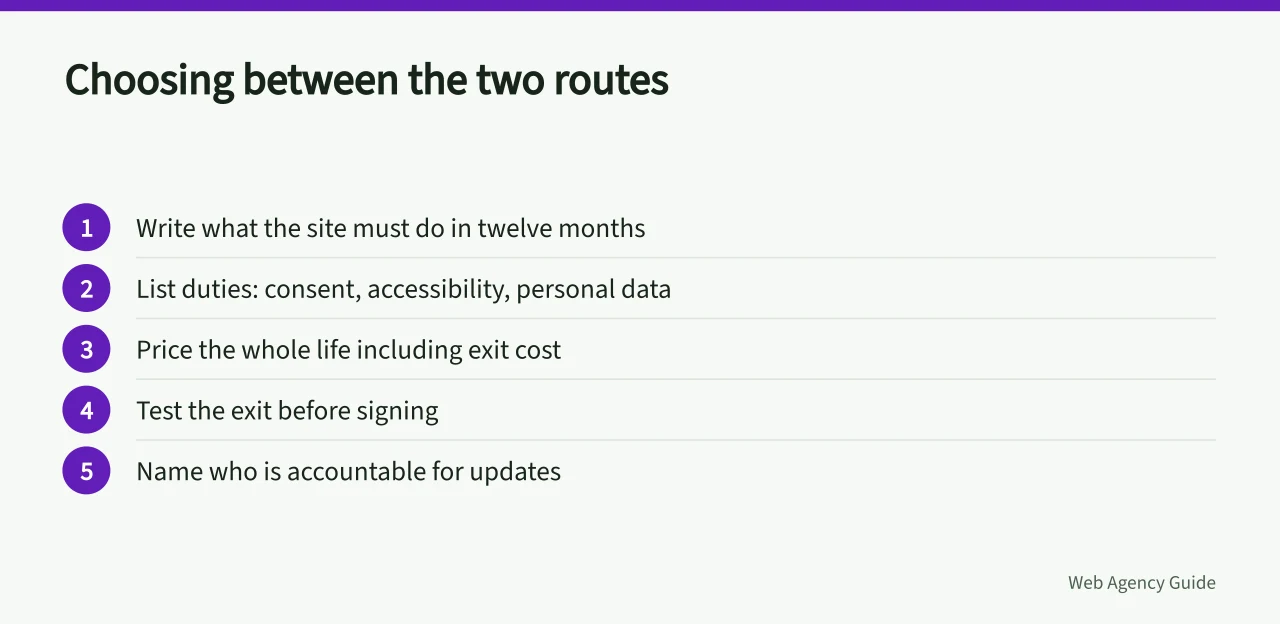
- Write down what the site must do in the next twelve monthsenquiries, payments, bookings, or nothing beyond a brochure.
- List the duties that follow from thatcookie consent, accessibility under the Equality Act 2010 with WCAG as the working benchmark, and any personal data the site will hold.
- Price the whole life, including hosting, licences, updates and the cost of leaving.
- Test the exit before signing. Ask what you can export, in what format, and at what notice.
- Name the person accountable for updates. If nobody internal will do it, budget for someone who will.
If the work is quoted by the hour, scope control matters more than ownership. The notes on web design agency hourly rates explain what the bands cover.
Common questions
Is a WordPress agency cheaper than a website builder?
Not on day one. A builder spreads a small cost monthly, while an agency charges a build fee up front. Compare the first two years in full, licences included.
Do I own the website if I use a builder?
You usually own the domain and the content you upload. The platform, the templates and the editor stay with the provider.
Should I hire a WordPress developer or use a builder?
Hire a developer when the site needs custom behaviour, integrations or a compliance trail. Use a builder when a small set of pages will do the job.
Can I move a builder site to WordPress later?
Often yes, with content copied by hand or by a migration tool. Layouts rarely transfer cleanly, so plan it as a rebuild with a content audit.